Free sample · Week 1 of 10
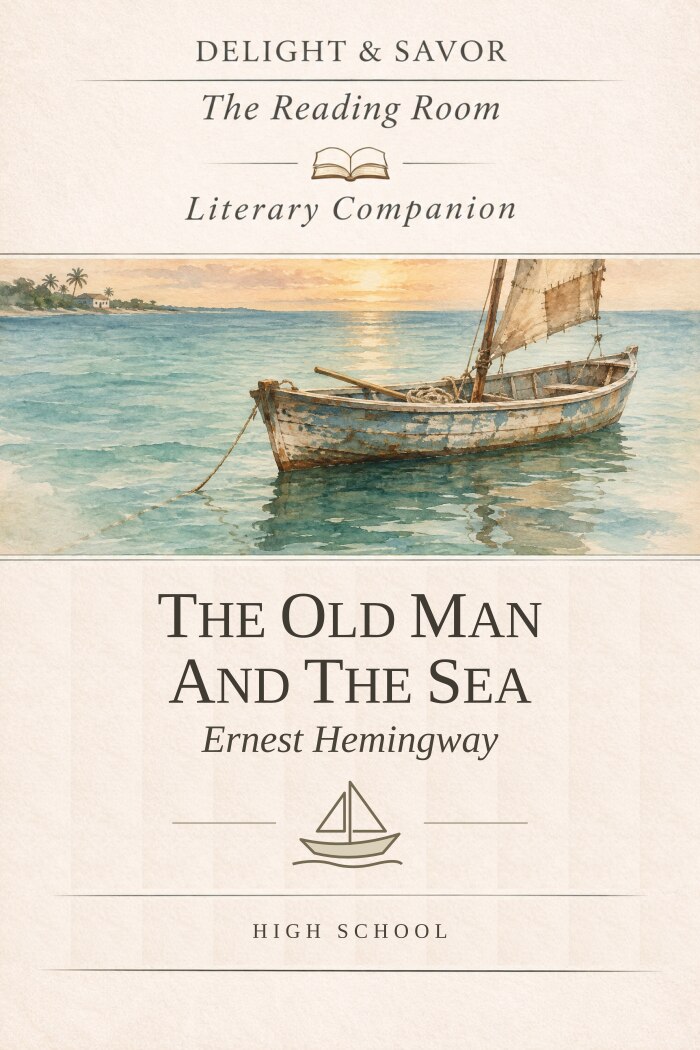
The Old Man and the Sea
Entering Hemingway’s World: Santiago, Manolin, and the Sea
The Art of Attention
When I Heard the Learn'd Astronomer
Walt Whitman
Read the poem aloud. On the second reading, listen for the moment the speaker steps outside.
When I heard the learn'd astronomer,
When the proofs, the figures, were ranged in columns before me,
When I was shown the charts and diagrams, to add, divide, and measure them,
When I heard the astronomer where he lectured with much applause in the lecture-room,
How soon unaccountable I became tired and sick,
Till rising and gliding out I wander'd off by myself,
In the mystical moist night-air, and from time to time,
Look'd up in perfect silence at the stars.
Which word opens the first four lines? Where does the speaker leave the room?
Keep talking
Read the first four lines, then the last four. What changes in the sound?
What can the speaker learn by looking up at the stars? Listen for how Santiago learns by watching the sea.
 Keep it
Everyone copies all eight lines into a commonplace journal. Younger writers can spread the copying over several days and illustrate the page.
For older readers
Write about a time you understood something by seeing or doing it yourself.
Choose a short reflection or a poem. Give the reader a detail they can see, hear, or touch.
Read & Narrate
Listen for what Manolin does for Santiago before the old man sets out.
Read pages 1–27 aloud together. Close the book. “Introduce me to Santiago and Manolin. Tell me what happens before Santiago heads into deeper water.”
That’s a full lesson for today.
Other ways to join the reading
The Old Man and the Sea · Use the same pages for an older reader.
The Boy and the Whale · Read the picture book together. In later weeks, return to one illustration.
Look Closely
Find the description of the sail and Santiago's eyes. How are they different?
Keep talking
Why would Hemingway give us these apparently conflicting details so early?
What is the difference between being unsuccessful and lacking dignity?
What can a person possess when outward appearances suggest failure?
The Sea as a Living Presence · Man & the Natural World
Find the passage about the different ways fishermen speak of the sea.
What does Santiago’s choice of words reveal about his relationship with it?
Can affection and danger belong to the same relationship? What does the passage suggest?
Keep it
Which passage made you pause? Read it aloud, then copy it with its page number. Write two or three sentences about why you chose it.
Other ways to keep it
Draw a moment connected to our Question to Carry; copy or dictate a sentence you wish to remember.
Draw or orally narrate an important moment, then write a few sentences that help answer the Question to Carry.
The Writing Connection Optional
Notice → Claim
From observation to claim. One small writing practice that will help you build toward a short composition.
Try it aloud
Tell someone one thing you noticed about Santiago. Finish your thought with “This suggests ___ because ___.”
Try it in writing
Write two or three sentences: a specific claim, one detail that led you to it, and—if ready—why it matters.
Savor It Optional
Songs of the Sea
Listen to the traditional song Shenandoah. Where does the tune seem to linger?
How does the sound of the song change the world you imagine around Santiago?
Relation Study Optional
Santiago’s Hands, Santiago’s Sea
Bring a small part of the fisherman’s world into your own hands and enjoy a glimpse of the sea together.
Try · A sailor’s bowline
With a short piece of soft rope, learn to tie a bowline: form a small loop, bring the working end up through it, around the standing rope, then back down through the loop. Pull it snug and see how it makes a fixed loop. This is for learning, not for climbing or safety-critical use.
Together · Watch the sea at work
Watch a short nature clip of a marlin, flying fish, or sea turtle. Then share a simple snack and wonder what Santiago would notice that a casual visitor might miss.