Free sample · Week 1 of 10
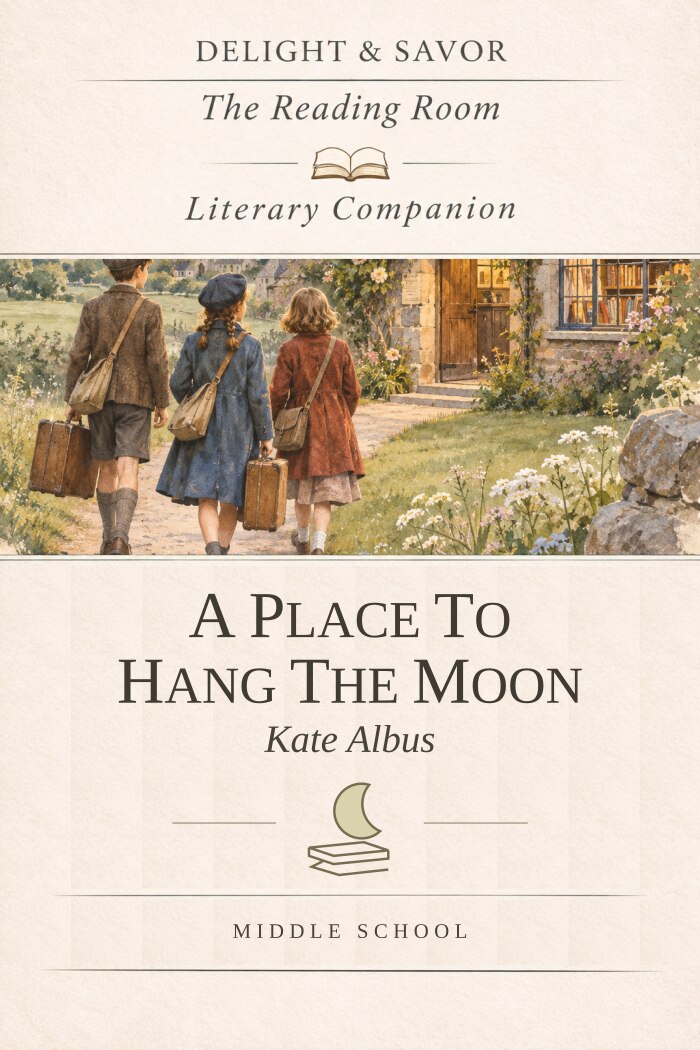
A Place to Hang the Moon
Three Children, One Hope
Read & Narrate
Meet William, Edmund, and Anna. Listen for what they hope to find.
Read chapters 1–2 aloud together. Close the book. “Tell me how William, Edmund, and Anna come to need a home.”
That’s a full lesson for today.
Other ways to join the reading
The Guernsey Literary and Potato Peel Pie Society · Read the first of ten portions in your edition.
The Lion and the Unicorn · Read the picture book together. In later weeks, return to one illustration.
Look Closely
Find a moment when one of the siblings helps or protects another. What does that person do or say?
Keep talking
Return to that action. What might the child be worried about? Which detail makes you think so?
When their familiar home changes, what do the children still have in one another?
What holds a family together when its familiar home is gone?
An Unusual Plan · Courage & Kindness
Find the plan Mr. Engersoll proposes.
What dangers and hopes are contained in his plan?
What makes setting out into the unknown courageous?
 Keep it
Copy a passage about William, Edmund, or Anna leaving home. Note the page. Write two or three sentences about what holds them together.
Other ways to keep it
Draw a moment when one child cares for another. Copy a meaningful word or sentence from the chapter, or dictate one to a parent.
Draw or narrate a moment of sibling care. Write a few sentences explaining how it helps answer our question to carry.
The Writing Connection Optional
Precise nouns & telling details
Exact nouns help a reader picture the world of the story. Imagine one small possession that a child might pack when leaving home; name it precisely, and consider what it might reveal.
A small blue notebook rested inside the worn suitcase.
Rewrite this general sentence using two particular objects and one telling detail:
The children packed their things.
Try it aloud
Name one object a child might pack. Tell someone what the object suggests about the child.
Try it in writing
Write two sentences describing an imagined possession precisely and explaining what it might suggest about the child who packed it.
Savor It Optional
The Last of England — Ford Madox Brown
Picture study. Look silently for one minute. Look away and narrate what you remember; then look again. What detail had you missed?
See the paintingHow does this painting change what you notice about the story, the world, or your own life?
Relation Study Optional
Experience the Blackout
Step briefly into the everyday world of wartime Britain. Try a small experiment with light, then share a historical account and a simple wartime-inspired food. These are invitations to curiosity, not a reenactment of danger.
Try · A blackout experiment
After dark, turn on a lamp in one room, close the curtains, and—with an adult—step outside to notice any light escaping around the edges. Back inside, try covering gaps with a towel or dark cloth. What changed? During the Second World War, British households were asked to keep lights from being visible outside. Leave exits clear and never cover hot lamps or lightbulbs.
Together · An evacuee’s story and a wartime kitchen
Listen to a short firsthand recollection or museum oral-history clip from someone who was evacuated from Britain during the Second World War. Then prepare a simple wartime-inspired dish together, such as potato cakes made from cooked mashed potatoes and a little flour. It needn't be an exact ration recipe; enjoy the meal while wondering how an unfamiliar home might have felt to a child.